**Astronomy Picture of the Day**
18 November 2026
**A Medium-Sized Solar Flare**
Image: https://assets.science.nasa.gov/dynamicimage/assets/scien…
Credit: Mario Cogo
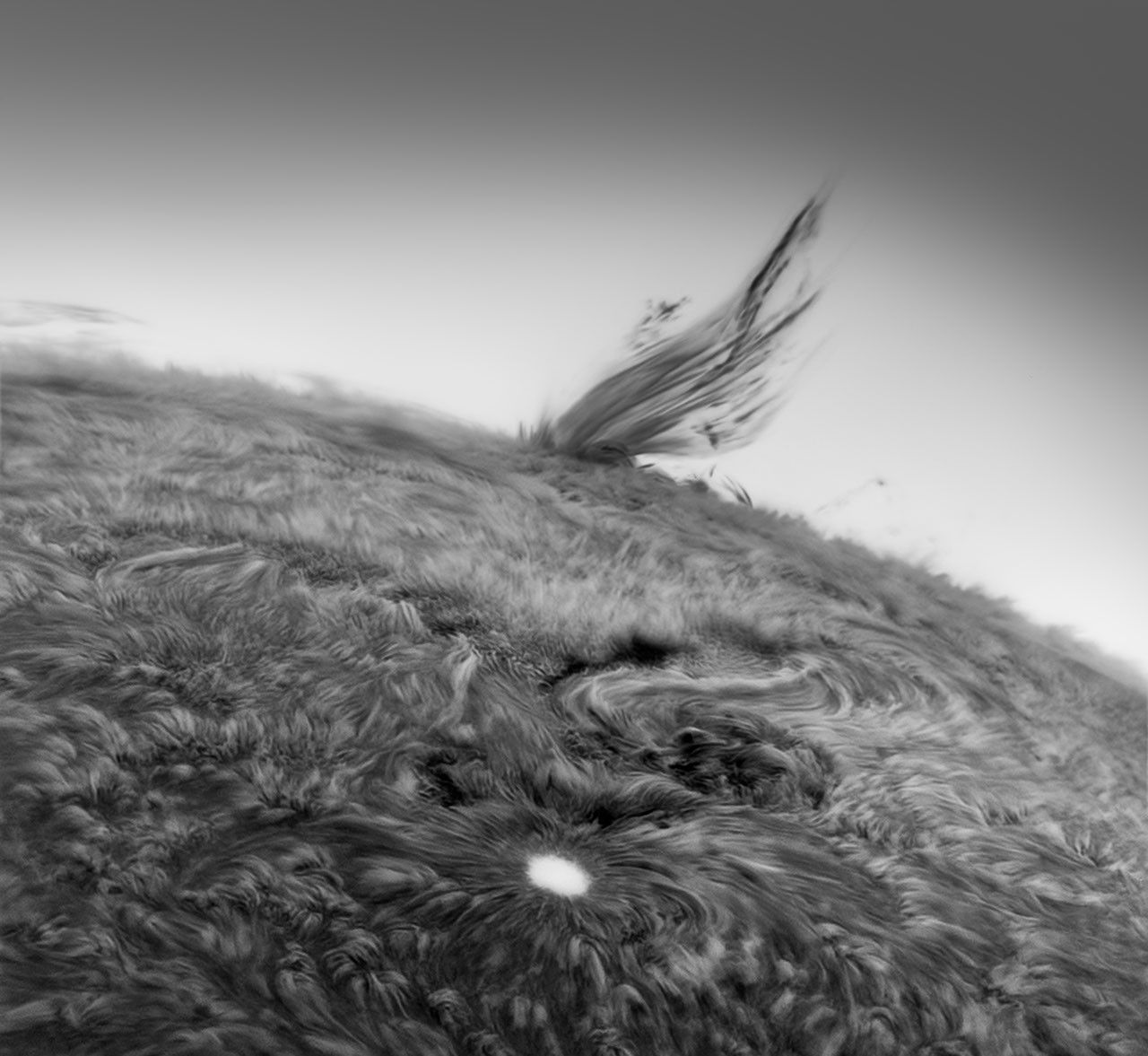
Explanation: Explanation: What a flare for the chromatic ! Today’s image captures a piece of the Sun ’s chromosphere , the layer of the Sun ’s atmosphere above its surface where the temperature rises . Why would the Sun become hotter farther away from its core ? This is potentially due to energy from the swirling magnetic fields extending up through the Sun’s atmosphere. Those same magnetic fields can twist and snap , releasing light and energetic particles as a solar flare . The H-alpha filter used for today’s image captures light from energized hydrogen atoms as they travel off the Sun’s surface during a flare on May 14, 2025. This flare was classified as an M1 based on GOES observations , meaning it was moderately bright in X-rays . M-class flares can cause radio blackouts at Earth’s poles and minor radiation storms that can harm astronauts. They aren’t even the most powerful flares ! NASA, NOAA , and other agencies monitor the Sun to predict and identify such storms so we can protect humans on Earth and in space. Tomorrow's picture: a horse of a different color
#APOD #Space #NASA #Astrogeek #Astronomy
https://science.nasa.gov/image-article/apod-2026-november…
18 November 2026
**A Medium-Sized Solar Flare**
Image: https://assets.science.nasa.gov/dynamicimage/assets/scien…
Credit: Mario Cogo
Explanation: Explanation: What a flare for the chromatic ! Today’s image captures a piece of the Sun ’s chromosphere , the layer of the Sun ’s atmosphere above its surface where the temperature rises . Why would the Sun become hotter farther away from its core ? This is potentially due to energy from the swirling magnetic fields extending up through the Sun’s atmosphere. Those same magnetic fields can twist and snap , releasing light and energetic particles as a solar flare . The H-alpha filter used for today’s image captures light from energized hydrogen atoms as they travel off the Sun’s surface during a flare on May 14, 2025. This flare was classified as an M1 based on GOES observations , meaning it was moderately bright in X-rays . M-class flares can cause radio blackouts at Earth’s poles and minor radiation storms that can harm astronauts. They aren’t even the most powerful flares ! NASA, NOAA , and other agencies monitor the Sun to predict and identify such storms so we can protect humans on Earth and in space. Tomorrow's picture: a horse of a different color
#APOD #Space #NASA #Astrogeek #Astronomy
https://science.nasa.gov/image-article/apod-2026-november…